
Better, Faster, Narrower
How optimisation culture erodes adaptability in advertising and beyond

I often think that it is interesting to look at the way groups approach solving problems. In the way that we judge effective leadership and what positive momentum looks like. I have been thinking about this recently because, in my opinion at least, in most organisations there is a quiet conviction that effort ought to be easily visible.
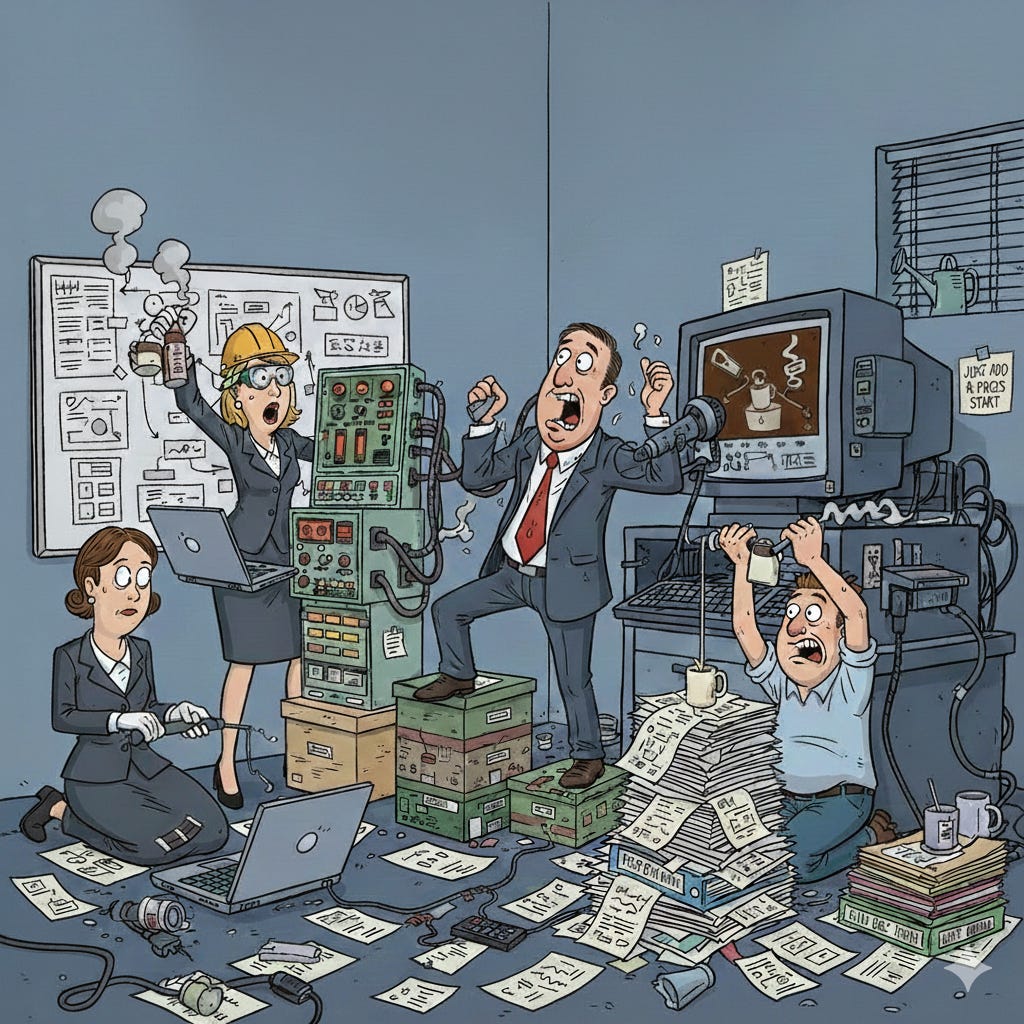
It comes through in the choreography of meetings, in the velocity of decks, in the way “pace” acquires a cult like status of virtue. Thinking becomes credible when it produces clear outputs. Effort becomes respectable when it can be tracked, allocated and updated by close of play. This culture of optimisation that so many of us live in amplifies this preference. When progress is measured in short cycles, when performance is reviewed against immediate signals, the behaviours that thrive are those that deliver quickly.
Break the problem down. Assign it. Report it. Improve it. Better. Faster. Stronger. Repeat until the question is solved, it’s a way of working that is not new or novel to most.
Now consider a simple statistical reality. Somewhere in the region of one in five people process information in ways that diverge meaningfully from the norm. A substantial minority of neurodivergence whose cognitive rhythms may favour depth over speed, systems thinking over tight workstreams, pattern-building over incremental refinement.
When organisations optimise for visible, rapid progress, they do not consciously exclude these modes of thinking. They simply create an environment in which they are harder to exercise and contribute. Cognitive variance becomes a drag on hitting the next milestone. Those different working patterns feel like inefficiency. In many cases this becomes and argument for inclusion, but I do not see it that way. I see it as a sign that the culture or optimisation is not as optimised as we might believe.
Nature, for example, which has no HR department and no patience for inspirational posters, has a slightly different tolerance for deviation.

A gazelle that has spotted a predator does not always do the sensible thing. Instead of running immediately, it sometimes leaps high into the air, legs stiff, making itself conspicuous at precisely the moment concealment might seem wise. This behaviour is known as stotting, or pronking. Biologists suggest it functions as an honest signal to predators: this animal is fit, alert and unlikely to be worth the chase.
It is a costly act. It expends energy. It increases visibility. It appears inefficient. In a well-optimised organisation, it would be stopped at once. A threat has been identified and there is an approved response. The gazelle opting for interpretive dance could reasonably expect to be put on a performance plan.
There is something similar that can be seen in the behaviour of bees. The waggle dance looks like the triumph of coordination. One forager finds nectar, returns and the colony aligns with admirable efficiency. It is the dream of any organisation that believes in a single source of truth and incremental progress.
Yet colonies do not rely on obedience alone. Some bees ignore the dance and scout anyway. Under stable conditions that behaviour appears inefficient. Yet when their environment shifts, when yesterday’s nectar dries up or new sources appear elsewhere, those deviations become the difference between persistence and collapse.
The hive survives because enough bees are willing not to follow the optimisation.
I don’t think anyone could look at the current world situation and conclude it is stable. Political leadership in major economies is volatile and polarising, wars are grinding on and technology is reordering labour markets before institutions can react. In that environment, tightening coordination around existing signals produces an impressive sense of control. It also narrows the range of responses available when those signals expire.
There is still a great deal we can learn from the way natural systems preserve adaptability. Because optimisation culture, for all its claims to rigour, can end up squeezing out the very variance that allows systems to adapt.
Advertising provides a useful test case, largely because its purpose is simple if hard to achieve. The role of advertising is to help companies sell more, at a better price, across a broader and more profitable mix. Volume, price and mix form the commercial reality that sits beneath the language of campaigns and dashboards. Cut through the noise and the work is either successful or it is not.
Consider what happens inside a business or an agency when a truly complex challenge/problem arrives. Not a tidy brief with a single audience and a short purchase cycle, but a situation involving multiple products, overlapping segments, conflicting signals, different time horizons, local and national pressures, consumer and SME realities, and data that refuses to resolve into a single story.
The first honest response to that level of complexity is disorientation.
It does not last long.
Workstreams appear, we break it down and individual tasks are issued. Progress updates become daily, because daily progress suggests control. Activity accelerates as movement itself becomes evidence of competence.
There are problems for which this works. Some questions are crossword puzzles. Break them apart and each clue can be solved in relative isolation. Others are not.
A Sudoku is different. Each number constrains every other number. If you try to complete it one small box at a time without holding the entire grid in mind, you quickly trap yourself. Local optimisation leads to incoherence and failure. Space is filled, progress is visible, all whilst painting yourself into a corner.
There are many commercial challenges in marketing are far closer to Sudoku than to crosswords.
Customer segments overlap. Pricing shapes mix. Mix shapes brand perception. Perception influences elasticity. Elasticity influences media efficiency. Channels interact. Time horizons collide. The system is tightly coupled.
Approach that kind of problem as though it were a collection of independent tasks and you can generate a remarkable amount of activity. Thirty parallel workstreams create momentum. They also risk obscuring whether anyone has understood the grid as a whole.
The harder work is integration. A small group holding the entire system in view, resisting the urge to propose solutions before the shape of the problem is clear. At first it produces little that can be circulated. From a distance, it resembles inertia. In practice, it sharpens every subsequent decision.
If optimisation were the only virtue, orchestras would dispense with conductors and rowing crews would abandon the cox. The musicians could simply play louder and faster, creating deafening rhythmless noise. The rowers could pull harder and harder and efficiently veer into the riverbank.
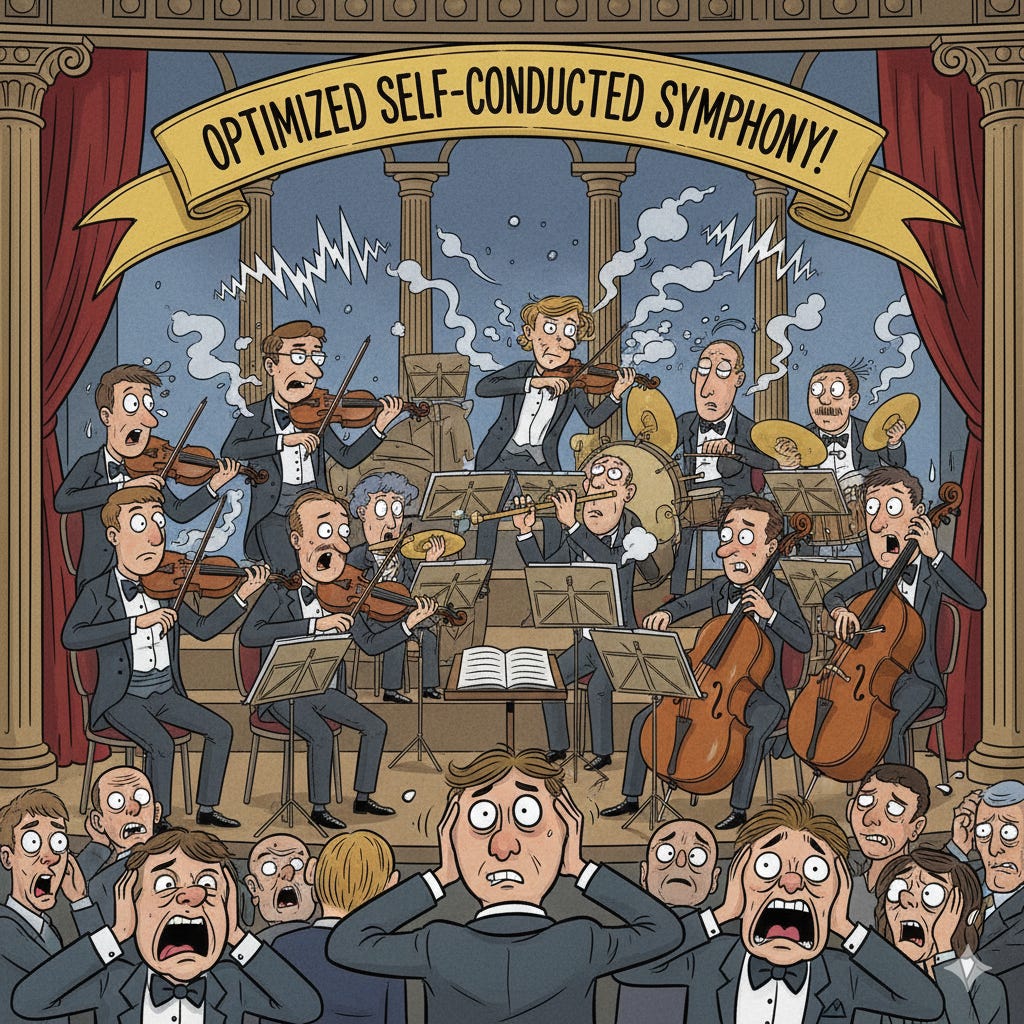
This same logic appears in how we run campaigns. When optimisation becomes the organising mindset, environments that allow constant adjustment will dominate. Creative is tweaked in near real time. Audiences are refined. Bids are adjusted. Placements are paused and restarted. Performance is reviewed in short intervals and interventions follow quickly.
Large digital platforms are structurally designed for this rhythm. They offer granularity, immediacy and scale. From an operational perspective, they fit an optimisation culture perfectly. So predictably investment follows that fit, whether it is the commercially sensible investment or not.
This would be unremarkable if the environments attracting that investment were neutral. They are not. Several of the largest platforms that benefit most from short-cycle optimisation have faced repeated scrutiny over scam advertising, content moderation, verification standards and user safety. These are not marginal issues. They are recurring features of the ecosystems in which a significant share of advertising money now sits.
The industry knows this.
Yet the cultural pull of measurable, adjustable performance typically outweighs the discomfort. Optimisation provides proof of activity. It provides numbers that move. It creates the impression of stewardship. Calling out structural weaknesses in the environments that enable that optimisation requires a different kind of courage, one that is less easily graphed.
Advertising money sustains modern infrastructure, when billions are directed into systems with a higher propensity for fraud and harmful content, that capital reinforces those systems’ centrality. Sustained investment without sustained pressure for reform will never improve the system.
Volume, price and mix remain the goal, they are stubbornly indifferent to how busy we look or how frequently we intervene.
Complex systems reward variance, they reward patience and they reward the ability to hold contradiction long enough for structure and simplicity to emerge. They also reward environments in which different cognitive rhythms are allowed to exist without being mistaken for inefficiency.
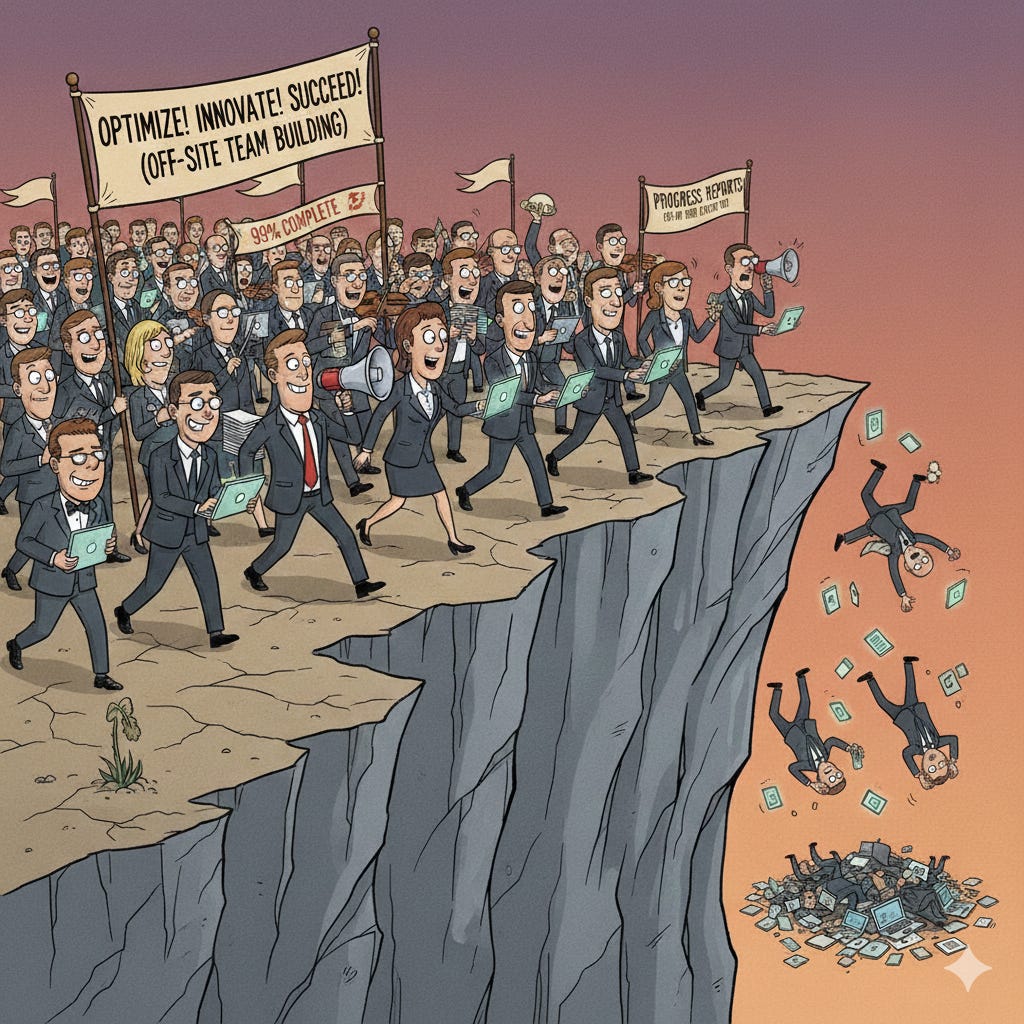
If we design organisations that equate impact with visible momentum, we will continue to fragment tightly coupled problems. If we equate responsibility with the ability to tweak something every ten minutes, we will continue to privilege environments that flatter that instinct. If we treat integration as inertia under the cult of optimisation, we will slowly optimise away the very capacity that allows businesses to adapt.
The lesson from gazelles and bees is not that inefficiency is noble. It is that adaptability requires slack. It requires deviation. It requires some people in the system who are permitted to doubt the map, to resist the first tidy answer, to sit with discomfort while others reach for movement.
Advertising has influence beyond its spreadsheets. It shapes markets, media and culture. The industry has agency in how it allocates capital and how it designs its own ways of working. This is not an argument that optimisation does not work; it’s a question of what it costs when it becomes the organising principle.
If we want to sell more, at a better price, across a broader mix, we need systems that can tolerate thinking which does not immediately look efficient. That includes protecting the minority voices who see differently, integrating before sprinting headlong and choosing environments with a view to their sustained effects rather than short-term adjustability.
Volume. Price. Mix. Better. Faster. Stronger
Optimisation can strengthen performance… A system that fights adaptation will eventually discover the limits of that strength