
Designing for Reality
We talk endlessly about effectiveness, yet often forget what it is supposed to describe: how advertising actually works.

At the Future of Media conference last week, I began with a line that drew a quiet pause: when we design for the average, we design for no one.
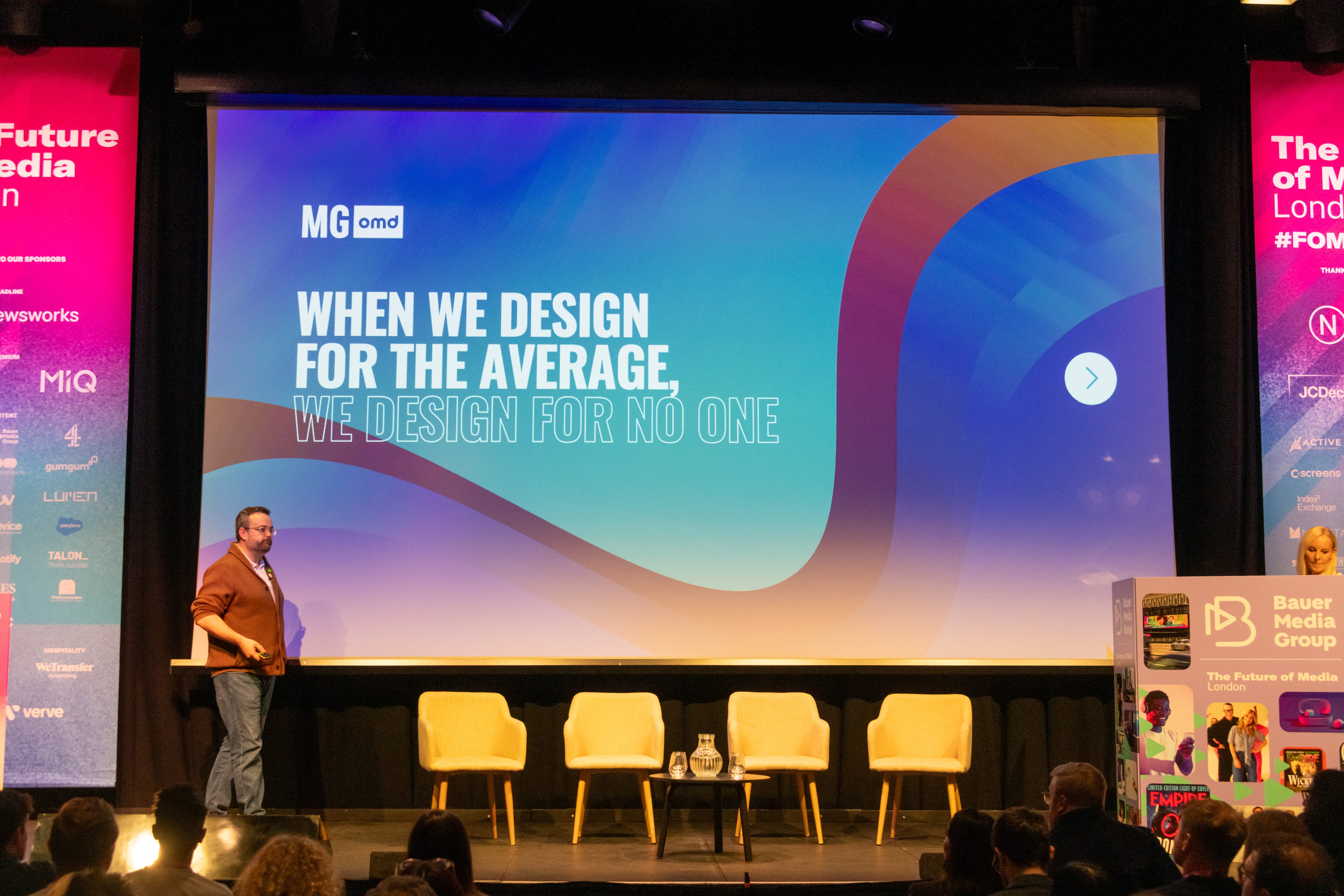
That thought isn’t abstract for me. I have ADHD, Auditory Processing Disorder, and Hypermobility Spectrum Disorder, all of which affect how I interact with the world: cognitively, physically, and emotionally. My brain and body don’t always follow the patterns others expect. It’s not better, not worse, just different. What it has meant, over time, is that I’ve spent my career watching marketing models treat people like me as edge cases.
The Problem with Averages
Advertising effectiveness isn’t just about how people make choices; it’s about how creativity shapes the conditions that make those choices possible, and how those conditions sustain growth over time. Yet so much of our industry still builds around the idea of an average consumer, a statistical composite that feels reassuringly solid but doesn’t really exist.
You can see it everywhere once you look.
Creative scores tell us what most people felt, not who felt it most intensely.
Channel plans are built on average reach deliveries, as if every impression carries equal weight.
High-attention media are ranked by average seconds of attention, even though attention itself isn’t distributed equally. It surges and drifts in unpredictable ways.
Each of these averages flattens the signal. They give us order, but they strip away insight. They make us feel confident about patterns that don’t exist in the lives of real people. Averages describe behaviour, not people. And people are where advertising begins.
How Advertising Really Works
The comfort of rules and benchmarks gives us the illusion of certainty, like a well-lit corridor through an unpredictable world. But effectiveness has never been about comfort. It is about how advertising helps businesses grow, how creativity, communication, and memory turn into volume, margin, and mix.
Advertising has one broad commercial purpose: to help businesses sell more, at a better margin and across a wider mix.
That is organic growth in its simplest form, the part of the balance sheet that proves creativity is a commercial force, not a discretionary cost.
The real task, then, is to reconnect how advertising works for people with how it creates value for business. Advertising helps businesses grow by improving the conditions in which people decide. It builds familiarity, trust, and ease, the invisible infrastructure of commerce. Those effects do not appear neatly in a single metric because they run through everything a company does.
It supports pricing by building mental associations that justify preference. It holds volume by keeping the brand easy to recall and easy to buy. It protects share by maintaining presence in culture so competitors struggle to dislodge it. In financial terms, that isn’t just sales uplift, it is risk reduction. Every remembered encounter lowers the cost of winning the next one.
The industry’s economic mistake is to treat advertising as a yearly cost rather than accumulated value. It is easy to count what it spends, harder to see what it builds: memory that compounds, trust that stabilises cashflow, and resilience that softens shocks. Businesses invest comfortably in R&D or technology because those returns look tangible. Advertising earns the same kind of return when it is understood as growth capital, an investment in future revenue, not an in-year expense.
For all our modelling and measurement, the fundamentals of how advertising works are surprisingly simple. It reaches people, builds mental and physical availability, creates emotional resonance, and makes brands easier to buy. Every other model, the funnel, the flywheel, the customer journey, is just an attempt to describe that process. Yet somewhere along the way, we started treating those descriptions as reality rather than metaphor.

The funnel is a tidy visual for a messy truth. It implies a single, linear path from awareness to purchase, when in reality people drift in and out of readiness, often for reasons we never see. Its simplicity is seductive because it gives us the illusion of control. We can move budgets up or down the funnel and pretend we are managing behaviour. But the funnel doesn’t describe how people buy; it describes how organisations wish they did.
These habits matter because they shape how we defend our value. When we reduce advertising to a mechanical sequence of inputs and outputs, we invite others to treat it as a cost to optimise, not a system that builds growth.
We have spent decades marketing products brilliantly while failing to market our own craft. Most businesses still see media as spend and creative as sparkle, not as engines of enterprise value. If we want to protect effectiveness, we need to market the marketing plan itself, to show how the pieces connect, how communication compounds, and how the right mix of reach, fame, and consistency builds balance-sheet value.
That means replacing borrowed metaphors with real systems thinking. Not funnels, not flights, but feedback loops: between exposure and experience, fame and memory, creativity and capital. Advertising works because these loops reinforce one another. Fame expands reach. Memory shortens decision time. Ease converts intention into action. Together, they create the conditions under which businesses grow.
I have always noticed patterns differently, which might be why I struggle with our industry’s love of tidy models. What looks linear on a slide rarely feels linear in life. Attention flickers. Emotion compounds. Memory drifts. Advertising works not because it controls those forces, but because it learns how to move with them.
Designing for Reality

Designing for reality begins with curiosity. It means paying attention to how people actually see, hear, and decide, and accepting that those experiences are not uniform. For someone with auditory-processing differences, subtitles may be the key to understanding. For another person, a half-seen visual cue may lodge in memory more deeply than a full campaign. Recognising those differences does not make work complicated; it makes it accurate. Designing for reality is also an act of responsibility. Inclusion is not only moral, it is commercial. The more people see themselves in a brand, the broader the base of buyers it can reach.
Our job now is to make that truth visible again. Not just in case studies or awards papers, but in how we talk about our work every day. Because the more clearly we can show how advertising really works, the harder it becomes to undervalue it.
Progress in this industry has never come from comfort. It comes from the willingness to look again, to test assumptions, question averages, and see difference not as deviation but as data. Curiosity is our real competitive advantage. It is what allows creativity to find its footing in commerce, and commerce to rediscover its humanity. Advertising does not need to choose between art and accounting. It needs to reconnect them. Because the more we understand people, in all their inconsistency, difference, and delight, the more value we create for everyone.
Effectiveness begins when we stop trying to perfect the model and start describing the reality it was meant to explain.